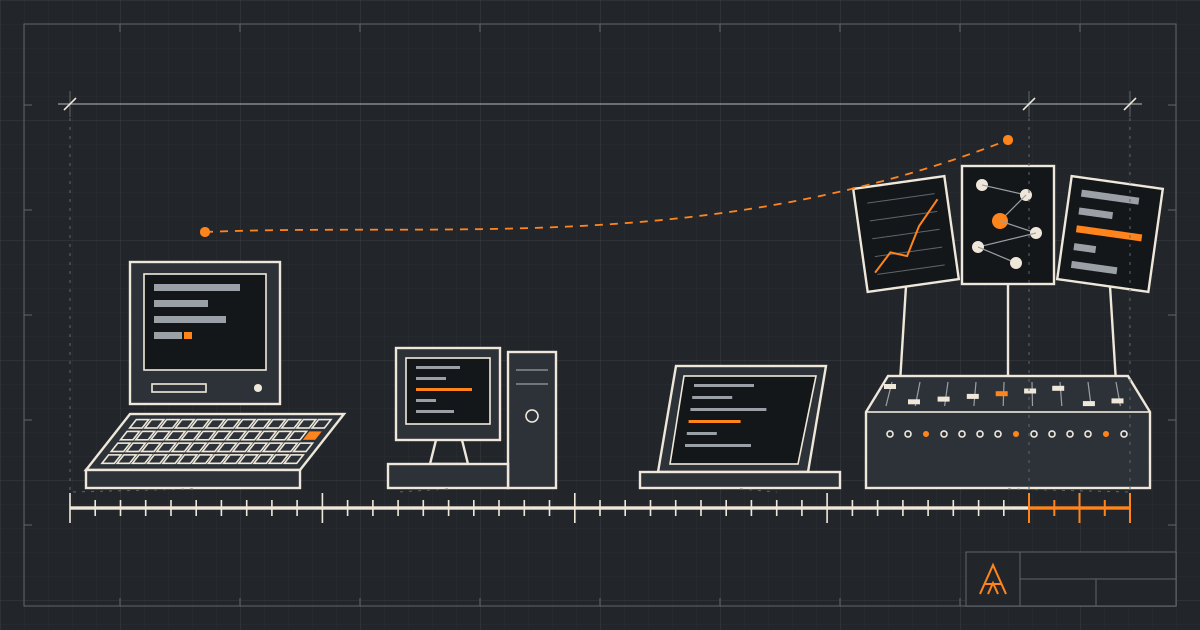
I see myself as a software developer to the core. I started writing code at the age of 9 in 1983 and I do not think there have been many months gone by since then, when I did not write at least some lines of code for some pet project. That’s almost 500 months of mainly uninterrupted coding.
But 2 months ago, I more or less stopped. Here is why.
First some more background:
During my career, I held different positions, many of which have been leaning quite heavily into the management side of things (I co-founded a few companies, I taught agile methodologies for some time, I held some project management positions). But even during those stretches, I always had some private coding projects running.
The reason why I stress this point so much is the following:
The Constant: 38 Years of the Same Beloved Inner Loop
I write code for 42 years now and I love what I am doing. I would still write code if nobody paid me for it. I see myself as one of the lucky few, who do what they like most for a living.
For the first 38 years of that career (until 2021), the core “inner loop” of development has not changed much.
- The languages changed (for me: 6502 and 68000 Assembler (really my first languages!), Basic, C, Turbo Pascal (school), Cobol (university), C++, Lisp, Java, C#, F#, JavaScript, TypeScript, Python, Golang and a few more)
- The tools changed (interpreter, compiler, IDEs, testing frameworks, CI/CD pipelines)
- The topology changed (first Standalone desktop apps, then LAN networks (2-tier, 3-tier business apps), later the internet (the “web”) social media, mobile, ...)
- The methodology changed (OOP, Functional, Waterfall to agile, XP to Scrum)
- The environments changed (First groups of developers in a shared office, then internationally distributed teams, then the dissolution of the “workspace” aka remote work and virtual teams)
- And obviously the hardware much evolved from my first Commodore C-116 (the one with the rubber keyboard!)
But the core loop at the end of the day if you want to produce working code still is
- Understand the business requirements
- Build a mental model of the target system in your mind
- Translate this mental model into interpretable lines of code by hitting the 102 keys on your keyboard in the right sequence and pushing the mouse here and there.
The Disruption: How Agentic AI Changed Everything
Starting in 2021 this shifted slowly, but since the end of 2024 the shift accelerates dramatically. Of course I speak about the arrival of generative AI.
I got beta access to Github Copilot in 2021 and annoyed my coworkers at Siemens (Sorry Matthias, Harald) on a daily basis with how insane this thing was. Then in 2022/2023 ChatGPT, especially GPT 4 bumped this up a notch. But only since Q4/2024 I feel substantial change in my own velocity.
- 2021: The early copilot helped me type faster (maybe 10–20% performance)
- 2023: The chatbots could help solve annoying bugs and basically replaced stack-overflow to find examples (another 20%)
- Late 2024 / 2025: But only the agentic coding tools (Windsurf, Cursor, Devin, Claude Code, Gemini CLI, Microsoft Codex) really started to change my “inner loop”.
- Understand the business requirements
- Build a mental model of the target system in your mind
- Translate this mental model into
interpretable lines of codespecs and documents that an llm can understand - Let the model implement
- Verify the results
I would guess that during the last 12 months my velocity (if for example measured in “story points per iteration”) doubled ceteris paribus. Which means with the same quality of code.
That is 2x over the last 12 months and 3x over the last 3 years.
If I extrapolate where this leads, I am convinced, that many of my core hard skills, foremost the “muscle memory” (you automatically and unconsciously write code and unit tests, you use proven design patterns, you observe good coding principles, you secure your app according to its needs, etc.) will devalue rapidly (!)
And this is where my performance comes from at the moment. This is why people pay me, because I can reliably create high quality pieces of software in a rather short period of time.
Today, I use my technical expertise to build a mental model of a software system that matches the customer’s requirements and then I just type it out as I type out these words here.
This is about to change. Translating mental models into lines of code is expensive and time consuming. And we will not do it much longer.
The Decision: Why I Traded My Keyboard for a Control Panel
I basically almost stopped doing it a few weeks ago. Remember: After 40 years of almost uninterrupted coding.
Why? I think I can still compete with Claude Code, etc. on my home turf (.NET backends with sophisticated architectures). But for how long? A year? Two?
I decided for myself that the most important skill I need is to thoroughly understand to use these tools as soon as they come to market. So these days I explicitly try to write as few lines as possible and automate as much as possible. Even if the performance gains are not that huge yet, or even negative sometimes. If I get the bot to create the code, I still honed my skill another bit.
So what comes next?
The ability to communicate what you want to achieve in a way that an AI coding agent can work with it will become paramount. This will require deep hands-on knowledge and intuition of the shifting and ever evolving world of AI models and tools.
How do I cut a problem into manageable pieces? What do I need to make explicit, what will the model derive on its own? How can I automate as many quality gates as possible to minimize my supervision time without sacrificing quality?
The Prediction: A 10x Shift and the Fate of the Holdouts
My prediction is, that I will further improve my workflows and at least 2x more during the next 12 months, mainly through the coding agents’ ability to take on ever bigger chunks of tasks and coming with this, the ability to parallelize work.
That would be 6x throughput compared to my 2021 baseline. Maybe even 10x. On average. Over all development related tasks. Not just typing code. This is crazy, but I stand by this prediction:
- 2021 me: 10 Story points per iteration
- 2024 me: 15 Story points per iteration
- 2025 me: 30 Story points per iteration
- 2026 me: 60 Story points per iteration
Or looked the other way round: I charge you only 1/6th of what I would have charged you in 2021 for the same work. The same feature that used to cost 1.000€ now costs 166€. All at the same level of quality.
Another prediction is that by 2027, I will code any developer on earth against the wall who tries to compete with me equipped with only stack overflow and no AI coding support at all.
- On basically every topic
- On every tech stack
- In any language.
There might be some holdouts where you need really specific domain know-how which is not (yet) accessible to my electronic colleagues. But apart from that... Don’t come to a gun fight with a knife.
What does this mean?
Getting acquainted to the new set of tools and the new colleagues is not optional anymore in our field. And more important: Learn what is important now.
Due to the inherent inertia of big organizations (private and public) and society in general you might keep your job or your company for a few more years, but you are a dead man walking already.
I just can’t see anyone in 2030 still be competitive without these tools. No way. You are just 10x, 20x slower and thus 10x, 20x more expensive. One by one these holdouts will be wiped out and become obsolete.
My Path Forward: How I Am Preparing
How do I prepare for what is coming?
I actively try to generate as much code and utilize as much compute as possible. Obviously in customer projects there are regulatory hurdles and if the customer does neither provide nor allow the use of any advanced AI tech, there is not much you can do.
For this reason, I actively reject projects which still did not realize that the world has already changed for good. If the customer is not at least actively interested and engaged in exploring on how to transition to the new world, it is basically a showstopper for me. I either want to drive innovation myself (and I love this) or participate in the learnings of the teams (even better!)
I feel the need to prepare for these changes as never I felt urgency before in my rather long career. The stakes are high. For individuals and organizations alike.
This is both exciting and a bit scary. But more exciting than scary. I am quite bullish on this. And I do not fear the end of our profession just yet. But a significant change is underway.
First published on 21 July 2025 on Substack. Original on Substack